

If you bill by client, the one job that matters most is tying every hour to a client and a rate. Most consultants start on a spreadsheet, and it works for a while. This guide shows you how to track hours, decide what is billable, and set a rate that fits. By the end you will know how to start this week.
Most consultants carry the same quiet worry whenever they bill a flat fee. You work the whole month and never really know if that client paid for your time or cost you a weekend. Left alone, one underpriced client becomes three, and a full calendar begins to feel like a trap. Lumea Direct was built by an agency owner to close that gap, so your logged hours become a number you can read.
How do you track billable hours across several clients at once?
Tracking several clients at once works when you attach the client to the hour before you start. Each entry then carries a client and a rate from the first minute, so nothing lands in the wrong place. In agency time tracking software like Lumea Direct, you pick the client, start the timer, and switch between three or four clients without stopping it.
Give every entry the same few fields each time you log it. That small discipline is the single thing that keeps a whole month of totals trustworthy. Miss the client or the rate, and the numbers quietly drift.
- The client the work was for, picked before the timer starts
- The rate that entry is counted at, saved on the entry itself
- Whether the hour is client work or general overhead
- A plain note on what you did, in case a client asks
With those four fields on every entry, a scattered week turns into a clean total per client. You can see where your time went without opening a second file. One timer runs at a time per person, so you never log an hour against two clients.
Log an hour the clean way
Should you run a timer or fill in a timesheet later?
A live timer beats an end-of-day timesheet, because memory fades fast. When you rebuild a day from memory, the ten-minute calls and quick replies vanish from the record. Those small pieces add up to real money across a month.
A timesheet you fill in later still beats no record at all. If a timer breaks your flow, block ten minutes at the end of each day while the work is fresh. The habit that fails is the one you push to Friday, because by then the days have blurred and you are guessing.
Either way the goal stays the same for every hour you work. You want an hour that carries its client and its rate the moment it happens. A tidy story invented on Friday is the thing you are avoiding.
Which of your hours can a client be charged for?
Billable time is the work you do on a client’s project, and everything else is overhead. Client calls, the SEO work, research for that account, and reporting for that client all bill. Pile the two together, and a 50-hour week can hide 15 hours that earned nothing. Your own admin, sales calls, and bookkeeping do not belong on any client total.
Keeping the two apart changes what your numbers mean. When general work stays off client totals, the hours against each client are the ones you can defend. Lumea Direct sends every hour to a client or to overhead, so the client view shows only billable work.
What rate should you measure your own hours against?
Measure your hours against a real effective rate, not your headline price. You cannot bill every hour you work, so the headline number overstates each one. SCORE’s pricing guidance warns that a consultant might bill about 1,200 hours a year. A full-time schedule holds roughly 2,080 hours, so most of the year is not billable (SCORE, Pricing Guidelines, PUB 701).
The table below shows how one target income lands on two very different effective rates. The whole gap comes down to the hours you can bill. One of these rates keeps you whole, and the other quietly drains your year.
| Target income | Hours you bill | Effective rate per billed hour |
|---|---|---|
| $120,000 | 2,080 hours | about $58 |
| $120,000 | 1,200 hours | about $100 |
Source: hours ceiling from SCORE Pricing Guidelines (PUB 701), retrieved November 13, 2026. Once you pick the rate that fits the hours you really bill, save it on every entry. In Lumea Direct a saved rate stays put even after you raise your price, so last quarter’s cost never shifts under you.

How do you tell which clients pay for your time and which cost you?
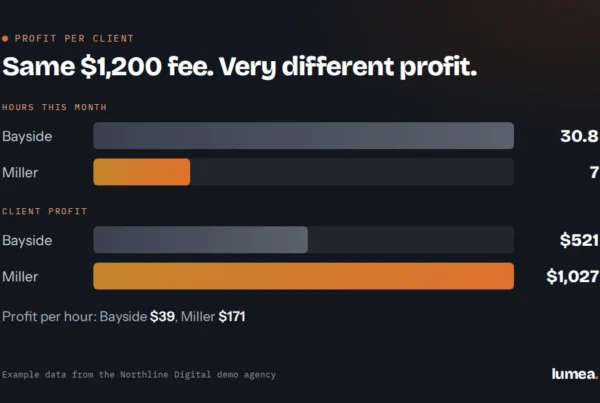
You tell a profitable client from a costly one by setting the fee against the hours you logged. A $2,000 project that took you eight hours is a healthy one to keep. The same fee against 30 logged hours is a client you are quietly paying to keep. Lumea Direct runs that math and gives each client a profit number instead of a guess.
This is the solo version of a problem every agency owner knows well. For one person the stakes feel sharper, because one bad-fit client eats a bigger share of the week. You feel that lost time in your own evenings and weekends.
Owners trade the same lesson in public every week on forums. The threads in the Reddit time tracking roundup say what consultants learn the hard way. The flat-fee client who seemed easy is often the one bleeding the most time.
How long do you need to keep your time records?
Keep your time records for a few years, because wage rules and tax rules both expect proof behind a number. The exact window depends on what the record is for and who it answers to. The simplest safe habit is to hold anything that supports an invoice or a pay figure for three years.
- Time cards and the records wage math rests on: two years, under US Department of Labor rules
- Payroll records, if you ever pay anyone: three years, under the same rules
- Documents that support income, such as invoices and receipts: kept per IRS guidance
- Your own logged hours behind a client invoice: kept as long as the invoice
Holding onto these records costs almost nothing once the software stores them. A billing dispute or a tax question then becomes a quick lookup instead of a scramble. The difference is one email versus an afternoon rebuilding a month you already worked.
Start the month knowing where your hours went
Michael Gleed built Lumea Direct after years of running his own agency’s hours and pay on a spreadsheet. A flat retainer hides the client who costs far more than they pay. Lumea ties every hour to a client and a rate and keeps client work apart from overhead. Each client then carries a profit number you can read.
You can start a 14-day free trial with no card and log a week of hours. The Lumea Direct pricing page starts at $49 a month for a single business and $98 for up to five clients. Log one honest week, and you will end the month knowing which clients pay for your time. This guide was written by Michael Gleed, Founder of Lumea Direct.
Common questions about time tracking for consultants
What is a good billable utilization rate for consultants?
A billable utilization rate around 70 percent is a realistic target, and the benchmark is 75 percent. The firms in SPI’s professional services benchmark billed 66.4 percent of their hours in 2025, down from 68.9 percent. The top firms still reached 75 percent. If your logged hours sit well below that, the fix is usually fewer low-value clients, not longer days.
How long should I keep my time records?
Keep time cards for at least two years, and payroll records for three. These windows come from the US Department of Labor’s recordkeeping requirements under the Fair Labor Standards Act, which apply when you pay employees. If you work solo, the safe habit is to hold anything that supports an invoice for three years. A client dispute can surface long after the work is done.
What records does the IRS expect from a self-employed consultant?
The IRS expects supporting documents that prove the income and expenses on your return. Its guidance on what kind of records to keep names sales slips, invoices, receipts, and deposit information as the documents behind your gross receipts. Your logged hours behind each invoice back up that income, so store the two together.
Do consultants have to bill in six-minute increments?
No, six-minute increments are a legal-billing habit, not a rule you have to follow. Lawyers bill in tenths of an hour, which works out to six minutes, and some consultants copy it on hourly work. If you bill flat project fees, track in whatever unit you like, because the point is seeing where your time went.