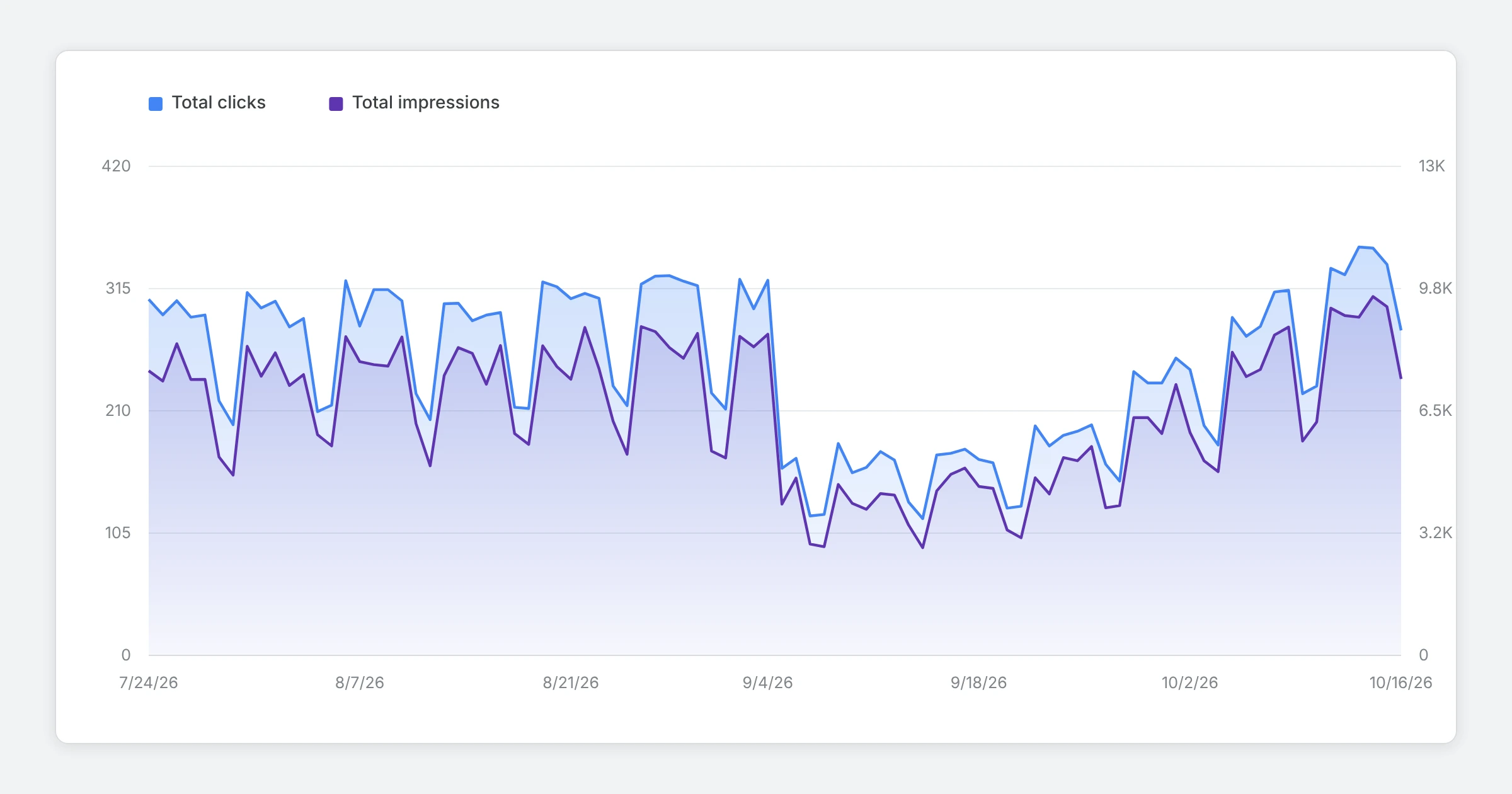

Explaining a bad SEO month to a client can be rough. Clicks are down 22 percent and the report goes out Friday. You’ve rewritten the same four sentences nine times now. Every version either buries the drop or sounds like an excuse, so you keep deleting it.
Here’s the fear sitting under all of it. One bad month rarely ends a client relationship, but one bad explanation often does. A client who feels managed starts shopping quietly, and the cancel email lands six weeks later.
So this page hands you the words. You’ll get Google’s own list of what causes a drop. You’ll also get a four-part script you can send today, plus three sentences to cut. For the full picture of what a monthly report should carry, read our guide to SEO client reporting.
What Do You Say When a Client’s SEO Numbers Go Down?
Say three things, in this order. Show the real number, name what caused it, then say what you’re doing next month. Those three moves take about four sentences. They work because they treat your client like an adult who paid for a professional opinion.
I run an SEO agency on my own SEO agency software, so I write these emails too. My rule has three parts and three bans. Show the real number, say what caused it, and say what you’re doing next month. Never hide the drop, never blame Google, and never promise it won’t happen again.
Why Did the Traffic Drop?
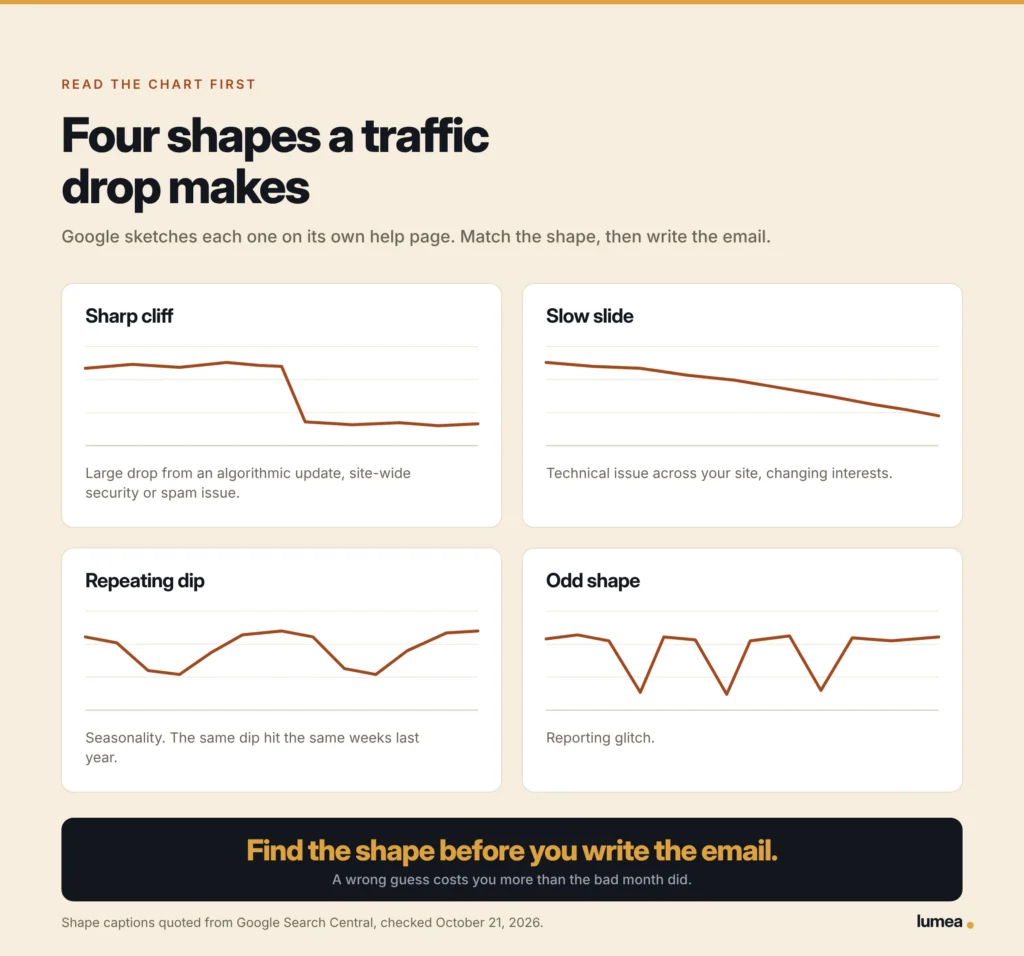
Google publishes seven reasons, and most months the answer sits on that list. It covers algorithm updates, technical errors, security issues, spam penalties, seasonality, site moves, and reporting glitches. Each one leaves a different shape on the chart, so find the shape before you write a word.
| What Google names | What it looks like | What you tell the client |
| Algorithm update | One sharp, large drop on a single date | A core update changed how Google ranks these pages. Here’s what we’re changing. |
| Technical issue | A slow slide, or a cliff if the server went down | Pages stopped getting crawled on the 9th. We fixed it on the 11th. |
| Security issue | A sudden drop plus a warning in Search Console | Google flagged a security problem. We cleaned it and asked for a review. |
| Spam issue | A drop paired with a manual action notice | Google issued a manual action. Here’s the fix and the timeline. |
| Seasonality | The same dip as last year, in the same weeks | This happened last year too, same weeks. Here’s both charts side by side. |
| Site move | Weeks of swing after a URL change | We moved URLs on the 3rd. Google says a medium site takes a few weeks. |
| Reporting glitch | An odd shape no other tool shows | The number looks wrong. We’re checking the data before we act on it. |
Google sketches these shapes on its own help page, which makes your diagnosis faster. A sharp drop points at an update or a site-wide problem. A slow slide points at technical trouble or fading interest. Seasonality repeats in the same weeks every year, so last year’s chart settles the question in about a minute. Pull that chart before you guess.
Is It a Real Drop, or a Number You Read Wrong?
Two numbers fool agency owners every month. Average position going down is good news, because position 1 beats position 9. And impressions holding flat while clicks fall points at your titles, not your rankings. Check both before you apologize for anything.
Google defines average position as the topmost spot your link held, averaged across every query. A lower number means you sat higher on the page. So a move from 6.7 to 2.3 is a win, even though the line on the chart heads down. Report that as a drop and you’ll scare a client over good news.
The second pair of numbers matters every bit as much. If impressions held steady while clicks fell, people saw you and picked somebody else. That points at your titles and snippets, or at a competitor with a better looking result. The fix is different, and so is the sentence you write.
What Do You Put in the Email?
Use four parts, in this order, and keep the whole thing under a hundred words. Lead with the number, name the cause, give the plan, then make one ask. A long explanation reads like a defense, and your client will feel it. Tight and specific reads like someone in control.
- The number. “Clicks were 1,240 in October, down from 1,590 in September.”
- The cause. “A core update landed on the 14th and hit our service pages hardest.”
- The plan. “We’re rewriting the three pages Google demoted and adding the FAQ blocks those results now show.”
- The ask. “Can you send me the two case studies we discussed? They go on the pages we’re rebuilding.”
The ask does more work than the other three combined. A client with a job to do stops feeling like a spectator watching money leave the building. It also proves you have a real next step, which is the thing they’re quietly checking for. Give them something small and specific.
What Should You Never Say?
Three sentences cost agencies clients every month. Each one feels safe while you type it, and each one reads as weakness on the other end. Cut all three out of your drafts before you send.
- “Rankings fluctuate.” Your client hears nothing at all in that sentence. Give the real number and the date instead.
- “Google changed the algorithm.” A cause is fine on its own. An excuse with no plan behind it is not.
- “It won’t happen again.” Nobody can promise the weather. Promise the work instead, since you control that.
Notice the line between naming a cause and blaming Google. Naming the cause is honest reporting, and it buys you the next sentence. Blaming Google is where your plan should have gone, and clients hear the difference every time. One of them sounds like a professional, and the other sounds like a shrug.
The Month You Explain Well Is the Month They Remember
I’ve sent these emails for years inside my own agency. The months I explained well are the ones clients still bring up on calls. Handled right, a bad month turns into proof you’re watching their business closely.
Lumea builds that belief into the client report itself. A decline shows as a gray arrow with the real number beside it. Red never appears anywhere in a client report. Red reads like an emergency, and you’re the one sending it. See what the report looks like, or check pricing and start a 14-day free trial with no card.
Questions About Reporting a Bad SEO Month
What causes a sudden drop in Google Search traffic?
Google names seven causes on its own help page. The list covers algorithm updates, technical issues, security issues, spam issues, seasonality, site moves, and reporting glitches. It also shows the shape each one makes on a traffic chart. A sharp cliff usually points at an update or a site-wide problem. A slow slide points at technical trouble. Start with the shape, then confirm it in Search Console. Source: Google Search Central.
Does a lower average position mean my rankings got worse?
No, a lower number is better. Google defines average position as the topmost spot your link held, averaged across every query. Position 1 is the top of the page. So moving from 6.7 to 2.3 means you climbed. Google also warns that position alone can mislead, so watch the trend over several months rather than one. Source: Search Console Help.
How long does it take to recover after a core update?
Google avoids the word recovery, and it gives no fixed timeline. Some changes show an effect within days. Google also says its systems can take several months to learn and confirm a site improved. It also warns against quick fixes and points you toward meaningful content work instead. If months pass with nothing, Google says it may mean waiting for the next core update. Source: Google Search Central.
Should I still send the report when the month was bad?
Yes, and send it on the normal day. A report that arrives late tells your client something went wrong before they read a single number. Silence also hands them time to invent a worse story than the real one. Send it on schedule, lead with the real figure, and put your plan in the first four sentences.